Studio boost · compressor · colour
The boost that hid inside a 1970s wireless rig.
Guitar players in the late seventies found something odd. Their new radio system made the guitar sound better than the cable did. Louder, tighter, pushier. Some of them started leaving it in the signal chain on purpose, even in the studio with the cable coiled on the floor.
Diversity 63 is that circuit, rebuilt. Put it in front of an amp sim and it does what it did then: adds body, evens out your picking, and shoves the whole thing forward.
Why a radio made guitars sound better
Nobody set out to build an effect. In 1976 you could not put a guitar on a radio link without it hissing, so the engineers squashed the signal two to one going in and stretched it back out coming out. They lifted the treble before the transmitter and dropped it again at the receiver. They hung a lamp and a photocell across the input so a hard strum could never clip the link. Then they gave the receiver thirty decibels of clean output to drive whatever came next.
Every one of those was a fix for a problem, and every one of them was meant to be inaudible. Together they were not. The squash-and-stretch pair does not quite cancel, because the two halves react at different speeds. Your pick attack gets flattened on the way in and handed back about four milliseconds late. That lag is the whole trick: notes bloom instead of spiking, quiet playing comes up, loud playing stays put, and the guitar arrives at the amp sounding like it has already been mixed.
Who used them
These systems were all over arena stages between 1977 and the mid-eighties. The players most often associated with them are the ones who used them in the studio rather than just on tour: guitarists in AC/DC and Van Halen among them, along with Rick Derringer. Several rock records everyone knows have one of these units somewhere in the chain, not for the wireless part but for what it did to the tone on the way through.
Mentioned as history. Nobody named here is connected to this plug-in or has endorsed it, and no recording is reproduced or sampled.
What you would use it for
Most of the time, as an always-on boost. It sits before a drive pedal or an amp sim and makes it behave: the amp sees a steadier signal, so the gain stops surging on hard strums and stops thinning out on quiet ones. Rhythm parts get tighter without a compressor's obvious pumping.
With the output turned up it pushes an amp into breakup that stays clear rather than turning to mush, because the compander has already evened out what it is being fed. It works on bass and on drum room tracks too, where the same forward push shows up as weight rather than as brightness.
Signal path
| Input stage | Asymmetric, DC free. Second harmonic mostly, some third. |
|---|---|
| Optical limiter | Lamp and photocell. 3.5 ms attack, dual recovery at 80 ms and 620 ms, soft knee, ratio rises with drive. |
| Pre-emphasis | 150 µs, high shelf +11 dB from 1061 Hz, matched de-emphasis after. |
| Compander | 2:1 encode into 1:2 decode, broadband around −22 dBFS. Encoder 0.9 / 95 ms, decoder 4.5 / 240 ms. |
| Link | 42 Hz to 15 kHz, with a noise floor to match. |
| Receiver EQ | +4 dB at 110 Hz, +3.5 dB at 340 Hz, +3 dB from 3.8 kHz. |
| Output | Up to +30 dB clean. Switchable out of circuit. |
| Oversampling | 2×, linear phase, latency reported to the host. |
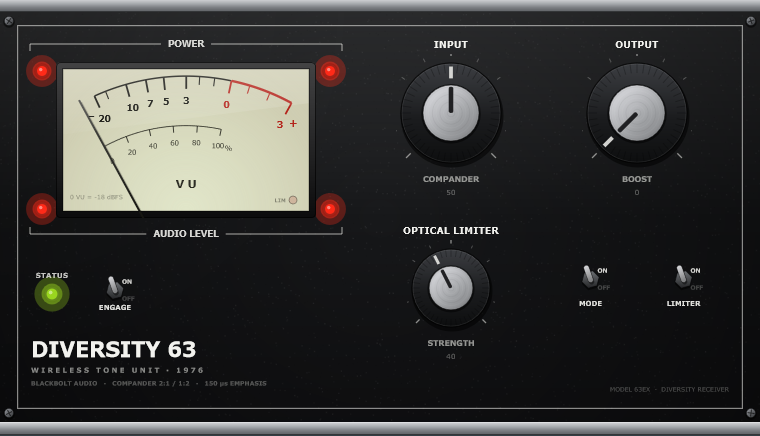
| Metering | Moving-coil simulation to ANSI C16.5. 0 VU is −18 dBFS. |
| Compression | About 2.4:1 across normal playing levels, measured. |
Three knobs
Input runs the compander. Output is the boost. The optical limiter has its own control, and two switches take the boost stage and the limiter out of circuit. That is the whole front panel, because that was the whole front panel on the original.
Input is gain compensated, so turning it up changes how hard the circuit is driven rather than how loud the result is. Across its full travel the level moves by three decibels. You can set it by ear without chasing the output.
Buying and activating
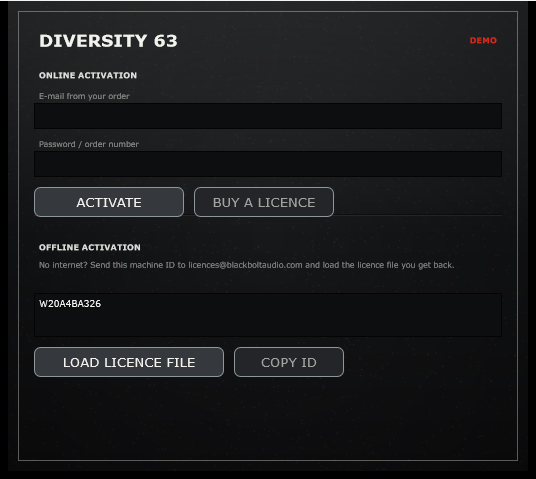
You get a licence key by e-mail. Open the plug-in, click the plate at the bottom right, paste the key, done. No dongle, no account to create, and nothing phones home afterwards.
Studio with no internet? The same window shows a machine ID. Send it to [email protected] and a licence file comes back that loads with one click.
Diversity 63 is an original implementation, written from published descriptions of how 1970s wireless companding worked. It is not affiliated with, endorsed by or connected to any manufacturer of hardware past or present, and contains no third-party code, circuit data or trade marks. All trade marks and artist names belong to their respective owners and are referred to here for historical context only.